Cosmetic Dentistry and Facial Aesthetics Under One Roof: How to Market Both
A dental practice that offers Botox and fillers should market them under the same brand, on the same website. Give each treatment its own page, and link dental and aesthetic pages where a patient’s question covers both. TMJ, gummy smile and lip balance are the treatments that belong to both sides, so start with those. Before any of it, confirm with your state dental board what your dentists may perform and advertise, because the answer varies by state.
Why do cosmetic dental patients also want facial aesthetics?
Because the smile sits inside the lower face. A patient planning veneers is looking at their lips, their gum line and the lines around their mouth in the same mirror. Many are thinking about lip filler or Botox at the same time. If their dentist does not offer it, they book it somewhere else.
Dentists also start with an advantage. They work in the mouth and lower face every day, they give injections daily, and patients already trust them with an expensive cosmetic decision. A patient who has had veneers with you is far more likely to book lip filler with you than a stranger from an ad.
The marketing usually lags behind. Dental marketing agencies rarely build aesthetic pages, and aesthetic agencies treat dentistry as an afterthought. In our October 2026 research into US medical marketing agencies, none of the ten we studied in depth connected the two in any meaningful way, and none treated TMJ or gummy smile as topics of their own. Few agencies write about this, which leaves room for a practice that explains both clearly.
What can a dentist offer and advertise?
This depends on your state, and this guide cannot answer it for you. It is general information, not legal advice.
State dental boards take different positions on neurotoxins and dermal fillers. Some allow dentists to use them for cosmetic as well as therapeutic purposes. Some limit use to treatments connected to dentistry, such as jaw muscles or the area around the mouth. Many set training requirements. Before you build a page:
- Read your state dental board’s current rules, or ask the board directly, for each treatment you plan to offer.
- Confirm your malpractice policy covers it.
- Check the advertising rules too. Many states limit what a dentist may claim, including use of the word “specialist”. Cosmetic dentistry is not one of the dental specialties recognized nationally, so a phrase like “cosmetic dentistry specialist” can be a problem in many states.
- Have a compliance advisor review the pages and ads before they go live.
Write the answers down. The pages you build should describe exactly what your dentists are trained and permitted to do, and nothing beyond it.
Which treatments are both dental and aesthetic?
Three treatments matter most, because they fix problems dental patients already ask you about.
Botox for TMJ, clenching and grinding
Patients search “Botox for TMJ”, “Botox for jaw clenching” and “masseter Botox near me”. Your page should present neurotoxin as one option among several: night guards, bite adjustment, physical therapy referral. Explain who it may suit, how many units and visits are typical at your practice, how long the effect lasts, and what it does not fix. Neurotoxin for TMJ is an off-label use, so state plainly that it is an option you assess case by case, and have your compliance advisor approve the wording. Do not promise a cure.
Gummy smile
This page matters most, because a dental practice can offer every fix. The options are neurotoxin to reduce how far the upper lip lifts, gum contouring, crown lengthening, veneers after gum work, or orthodontics. A med spa can offer one of those. Build one page that explains each option: who it suits, the cost range, how long it lasts and what it involves. Then help the patient choose. That page answers the patient’s real question, which is “what will work for me?”
Lip balance with a smile makeover
A new smile can change how the lips sit. Some patients want lip filler to frame veneers, or to restore lip support after full-arch work. Plan the sequence on the page: which treatment comes first, and how long to wait between them. Link it from your veneer and smile makeover pages.
After those, add the general facial aesthetics pages your dentists are permitted and trained to offer, such as forehead and frown lines or perioral lines, each with its own page.
Should facial aesthetics have its own brand?
No, unless the aesthetic side is a separate business (see below). Keep one brand.
- Your reviews carry over. Reviews saying your team is careful and gentle reassure a filler patient too.
- Your Google Business Profile carries over. Add the aesthetic services to your existing listing. A second listing at the same address is usually against Google’s guidelines unless it is a genuinely separate business with its own staff, phone number and signage. Ask before you create one.
- Your website’s standing on Google carries over. A new website address starts from zero.
- Patients already trust you. A new name has to earn that again.
What changes is the language. Inside a dental practice, “Facial Aesthetics” or “Facial Esthetics” reads better than “med spa”, and it tells patients the treatments are done by the same dental team. If you hire a separate injector, give them a profile page and say clearly what their role and credentials are.
A separate brand makes sense when the aesthetic side is a separate business: its own space, its own providers, its own booking, perhaps its own location. If that is your plan, it needs its own site and listing, and our med spa marketing guide is the better starting point.
How should the pages and galleries be set up?
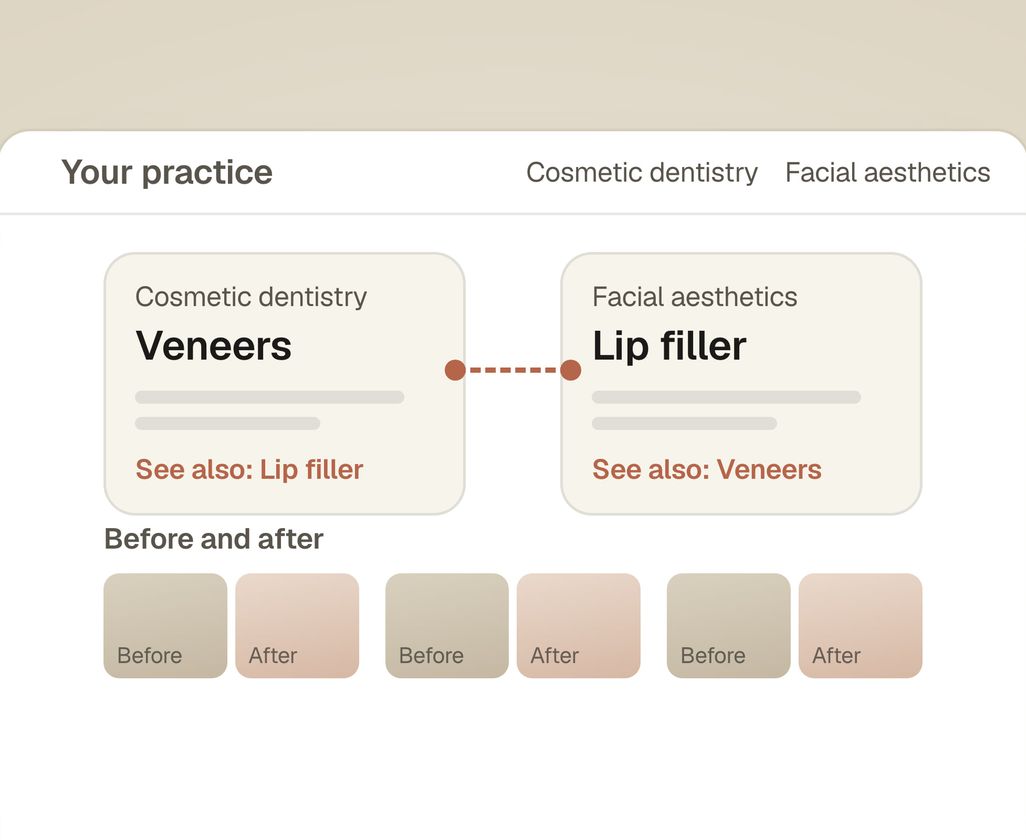
Give each side its own section, with a clear address for every page. For example:
- yoursite.com/cosmetic-dentistry/veneers
- yoursite.com/cosmetic-dentistry/smile-makeover
- yoursite.com/facial-aesthetics/botox-for-tmj
- yoursite.com/facial-aesthetics/lip-filler
- yoursite.com/gummy-smile
Put the gummy smile page at its own address, outside both sections, because it belongs to both.
Every treatment page, dental or aesthetic, should cover the same things:
- a two- or three-sentence answer at the top
- the cost range and what changes it
- who it’s right for
- the number of visits, recovery and how long results last
- who performs it and their training
- consented before-and-after cases
- a button to book a consult for that treatment
For galleries:
- One gallery per treatment, so a veneer patient is not scrolling past lip filler.
- Combined cases in both galleries, tagged clearly, such as “porcelain veneers and lip filler, same dentist”. Combined cases are strong proof, because few providers can show them.
- Written consent for marketing use, separate from treatment consent, naming where the photos may appear. Full-face photos identify a patient, so be careful about privacy and get the consent wording approved.
- Consistent photos before and after: same angle, light and distance, no retouching.
- A caption saying what was done, by whom and how long after treatment.
Our web design service builds this structure from the start, and our content service writes the treatment pages.
How should the dental and aesthetic pages link to each other?
Link where the patient’s question naturally crosses over, and nowhere else. Linking every page to every other page makes the site harder to use and tells search engines nothing.
Good cross-links:
- Veneers and smile makeover pages link to lip balance: “Some patients add lip filler to frame a new smile.”
- The TMJ page links to night guards, and the night guard page links back.
- The gummy smile page links to every option it compares.
- Lip filler and perioral pages link to the smile makeover page.
- Dentist profiles list both their dental and their aesthetic training, and link to both sides.
In the navigation, keep both sections visible at the top level. A patient who arrives on a dental page should be able to see, without searching, that you offer facial aesthetics too.
Offer one consult that covers both, such as a “smile and face consult”. It suits a patient planning a bigger change, and they get both answers in one visit.
How do you advertise injectables from a dental practice?
The same platform rules apply to you as to a med spa. Google treats neurotoxins as prescription drugs and limits ads that name them. Meta restricts before-and-after images in cosmetic procedure ads. Our med spa marketing guide covers those rules. Your state dental board’s advertising rules sit on top of them.
Your cheapest channel is the patients you already have. Mention the aesthetic services on your website, in your newsletter if patients have agreed to receive it, and in a short line from the dentist when it is relevant to the patient’s treatment. Give patients information, and never push them in the chair.
For paid search, start with the treatments where a dentist is the obvious provider: “Botox for jaw clenching [city]” or “gummy smile treatment [city]”. Send each ad to its own page. Google Ads management is an add-on with either of our plans, at one published price on our pricing page. Google charges the ads to your card, and we add nothing on top.
How does AI search treat a practice that does both?
Patients ask assistants “can a dentist do Botox?”, “Botox for TMJ near me” and “best place for gummy smile treatment in Denver”. A practice with clear pages for those questions, a dentist profile that lists the training, and consistent details across its listings gives the assistant something to quote. Our guide to getting a dental practice recommended by ChatGPT and Google AI covers the checks, and how AI search optimization works explains our method.
When should you get help?
If you are adding facial aesthetics to an established cosmetic practice, start with three things. Build the TMJ, gummy smile and lip balance pages. Set up galleries with proper consent. Link to them from your existing veneer and smile makeover pages. A good in-house team can do that in a few weeks.
Get help when the pages are not getting written, when you are rebuilding the site anyway, or when you want one team to market both sides. Our marketing for cosmetic and implant dentists page explains how we add aesthetic pages next to your dental pages, in the same plan. Our pricing is published, and plans are month to month.
The audit compares your practice with the top three practices near you on Google, for both your dental and your aesthetic treatments, and shows what to fix first. Get my practice audit.