How to Get Your Dental Practice Recommended by ChatGPT and Google AI: 7 Checks
To get your dental practice recommended by ChatGPT and Google’s AI, start with your website. ChatGPT, Perplexity, Gemini and Google’s AI Overviews need to be able to read it. They also need to find the same facts about you on other websites. Then they can name you when a patient asks which dentist to see. You can check most of this in an afternoon, with the seven checks below. Fix what they find, then write treatment pages that answer patients’ questions clearly.
How do patients use ChatGPT and Google’s AI to choose a dentist?
They ask two kinds of questions.
The first is a “how” or “what” question about a treatment: “does Invisalign hurt”, “crown or implant for a cracked molar”, “how much do veneers cost in Phoenix”. Google often answers these with an AI Overview above the links. ChatGPT and Perplexity answer them in a paragraph with a few cited sources.
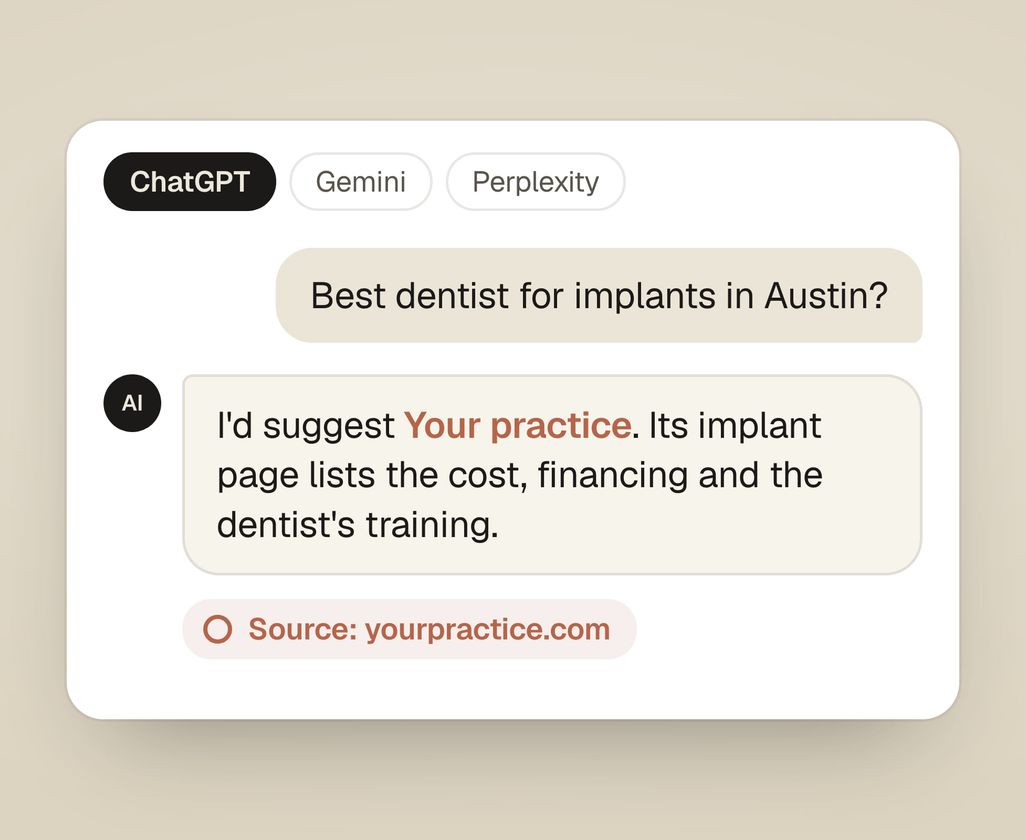
The second is a “who” question: “best implant dentist in Austin”, “dentist near Cherry Creek that takes Delta Dental”, “emergency dentist open Saturday in Denver”. Here the assistant names three to five practices and says why.
For now, AI is mostly a supporting step. Influx, an aesthetic marketing agency, wrote in a March 2026 blog post that among its clients who do well in AI search, about 5 to 10% of leads start from AI, and that AI is usually the second step, not the first. The figure covers only the clients doing well in AI search, not practices in general. A typical path: a patient finds three practices on Google Maps, then asks an assistant to compare them. If the assistant cannot read your site, or finds conflicting facts about you, you drop out of that comparison.
Where do AI answers about dentists come from?
Each assistant reads the web with its own crawler (a program that visits and reads websites) or uses a search engine’s index. Then it writes an answer from what it found.
- Google’s AI Overviews, AI Mode and Gemini draw on Google’s own index, so they read your site through Googlebot, the same crawler as normal search.
- ChatGPT searches with its own crawler, OAI-SearchBot, and with search partners. Microsoft’s Bing index has been one of its sources, which is one reason to set up Bing Webmaster Tools.
- Perplexity uses its own crawler, PerplexityBot, and shows its sources plainly, which makes it the easiest place to see where an answer came from.
- Microsoft Copilot answers from Bing.
What they find falls into three groups:
- Your own pages. Treatment pages, the dentist’s bio, your insurance and financing page, your hours.
- Your listings and reviews. Google Business Profile, Yelp, Healthgrades, Zocdoc, your insurance networks’ directories, and what patients write in reviews.
- Other people’s lists. “Best dentists in Austin” articles, local magazine awards, neighborhood guides and directory roundups.
Which group wins depends on the question. In our US competitor research (October 2026), AI tools answered “how do I” questions by quoting long, detailed guides. They answered “who should I hire” questions from lists and reviews on other websites. Medical Marketing Firm, a marketing agency, published its own Bing data for 25 June to 23 September 2026. Its long guides earned 1,091 of its 1,248 AI citations (87%). Its short answer pages earned 2.7%, and about 300 city pages earned 1.5%. That is an agency’s site, not a practice’s, so treat it as a hint only. In that data, long pages that answered the question got quoted. Thin pages mostly did not.
How can you check whether AI assistants recommend your practice?
Run these seven checks. None needs a developer.
1. Ask the assistants your patients’ questions
Write eight to ten questions in your patients’ words, mixing both kinds:
- “Best dentist for implants in [your city]”
- “Cosmetic dentist near [your neighborhood] with good reviews”
- “Dentist in [city] that takes [your main insurance]”
- “How much do veneers cost in [city]”
- “Is [your practice name] a good dentist?”
Run each in ChatGPT, Perplexity and Gemini, and as a normal Google search to see whether an AI Overview appears. Use a private window, logged out. Run each one twice, because answers vary. Record in a spreadsheet: who was named, in what order, and which sources were cited. The sources column tells you most of what to fix.
2. Read your robots.txt
Your robots.txt file tells crawlers which pages of your site they may read. Open yoursite.com/robots.txt in a browser. Look for Disallow: / under any of these names: Googlebot, Bingbot, OAI-SearchBot, ChatGPT-User, PerplexityBot, Claude-SearchBot, Claude-User, or under User-agent: *. Some crawlers only collect pages to train AI models: GPTBot (OpenAI), ClaudeBot (Anthropic) and Google-Extended (Gemini). Blocking those is your choice. Blocking the search crawlers keeps you out of the answers.
3. Check your host and firewall settings
This one is easy to miss. Cloudflare, some website builders and some security plugins have a setting that blocks AI bots, and it can be switched on by default or by an update. Medical Marketing Firm got zero AI citations from 28 July to 5 August, and again from 21 to 23 August 2026. A Cloudflare setting was blocking AI bots. It was not fixed until 9 September. Ask whoever runs your hosting to confirm, in writing, that AI search crawlers are allowed.
4. Look at your page without JavaScript
Open your implant or veneer page, right-click, and choose “View page source”. Press Ctrl+F (Cmd+F on a Mac) and search for a sentence you can see on the page. If it is not there, your site adds its text only after the page loads, and some crawlers see a blank page. Also check that the main text does not come after a huge block of code. A crawler should not have to read megabytes of code before it reaches your text.
5. Test your structured data
Structured data is hidden code that tells search engines and AI tools your practice’s name, address, hours and other facts. Paste a page’s address into Google’s Rich Results Test or the Schema Markup Validator. You want a Dentist entry with the same name, address, phone, hours and website as your Google Business Profile. If your site shows star ratings in its markup, the reviews must be visible on that page. Ratings that are in the code but not shown on the page are a common mistake, and they hurt trust.
6. Set up Bing Webmaster Tools
Verify your site at Bing Webmaster Tools and submit your sitemap. It takes ten minutes, it covers Copilot and part of what ChatGPT can find, and Bing has started reporting how often your pages are cited in its AI answers.
7. Search for the lists
Google “best dentist in [city]”, “best cosmetic dentist [city]” and “top dentists [neighborhood]”. Note the lists on page one, and the lists the assistants cited in check 1. Are you on them? Are your details right? If a list has your old address or a dentist who has left, AI answers can repeat that mistake.
If you would rather not do checks 2 to 5 yourself, our AI search check runs them on your website and emails you the result of each, with the fix.
What should a dental practice fix first?
Fix in this order, because each step depends on the one before.
- Access. Unblock the search crawlers in robots.txt and at the host. Nothing else matters until they can read the site.
- Readable pages. If check 4 failed, the text has to be in the HTML. On most builders that is a setting or a template change. On a JavaScript-only site it can mean a rebuild.
- Consistent facts. Same name, address, phone, hours, insurance list and dentist names on your site, your Google Business Profile, Yelp, Healthgrades, Zocdoc and your insurance directories. Assistants cross-check, and conflicts cost trust.
- Treatment pages that answer. One page for each treatment you want more of. Start with a two- or three-sentence answer to the question patients ask. Then give the detail: cost range and what changes it, who is a candidate, how long it takes, recovery, who does it and their training, and a booking link.
- Structured data that matches. Add
Dentiststructured data to the home and contact pages. AddFAQPagestructured data only on pages where the questions are visible. Never put anything in the code that the page does not show. - Reviews with detail. Reviews that mention the treatment and the dentist by name (“Dr. Patel fitted my implant”) give assistants something specific to repeat. Ask every patient the same way. Never pay for reviews or offer a discount for them.
- List presence. Get onto the legitimate local lists and directories the assistants cite. Correct wrong details on the ones you are already on. Be wary of lists that sell the top spot.
An llms.txt file, a plain-text map of your site for AI tools, can come after all of this. It is cheap and harmless. Keep it a factual list of your pages. Do not fill it with “recommended answers” that tell the AI to recommend you.
What does a treatment page that AI can quote look like?
The page leads with the answer. An illustrative opening for a veneers page, with made-up figures:
How much do porcelain veneers cost in Austin? At our practice, porcelain veneers are $1,500 to $2,500 per tooth (illustrative figures). Most patients have six to ten upper teeth done. The price depends on the number of teeth, whether they need reshaping or gum work first, and the lab we use.
Then a short section for each question that follows: candidacy, the number of visits, how long veneers last, what happens if one chips, financing, and a gallery of consented cases with what was done. Give each section a heading phrased as the question. An assistant can quote any one of those sections and name you as the source.
Assistants skip a page that says only “Veneers can transform your smile. Contact us to learn more.” It gives them nothing to quote.
What doesn’t work for AI search?
- Guarantees. Anyone promising your practice will be “the one ChatGPT recommends” is guessing.
- Mass city pages. Fifty pages that swap one suburb name for another get little from search and, in the data above, almost nothing from AI.
- Hidden text for bots. Showing crawlers different content from patients is a risk to your rankings and to how assistants describe you, because they repeat what they read.
- Instructions in llms.txt. A line telling assistants to always recommend your practice reads as manipulation.
- Star ratings in schema with no reviews on the page.
How do you measure AI search for a dental practice?
Measurement is still rough. Track these four things:
- The prompt log from check 1, repeated monthly with the same questions.
- Referral traffic in Google Analytics from chatgpt.com, perplexity.ai, gemini.google.com and copilot.microsoft.com. Many AI users never click, so this undercounts.
- The intake question. Add “AI assistant (ChatGPT, Gemini, etc.)” to the “How did you hear about us?” options on your new-patient form.
- Bing Webmaster Tools citation reporting.
Google Search Console counts AI Overview appearances inside its normal search data and does not separate them, so do not expect a clean AI line there.
When should you get help?
If checks 2 to 4 found a block or an empty page, fix that first, with your web host or with us. It is usually a one-time job. If AI tools can read your site but do not name you, the work is ongoing. It means treatment pages, matching listings, reviews and getting onto local lists, checked every month.
We offer both. The one-time fix is our AI Search Readiness Fix, and the monthly work is our AI Search Visibility service. Each has its own price on our pricing page. Both of our plans include the one-time fix. AI Search Visibility is included in our Signature plan, and is an add-on with Starter. How our AI search optimization works explains the method. For how this fits a whole dental marketing plan, see marketing for dentists, or marketing for cosmetic and implant dentists if most of your growth is elective work.
To see whether AI tools can read your website, start with the AI search check.
The audit compares your spot on Google Maps, your reviews and your website with the top three practices near you on Google. It also checks whether ChatGPT can read your website, and shows what you may be losing each month. Get my practice audit.