How Much Does Dental Marketing Cost a Month? What US Practices Pay
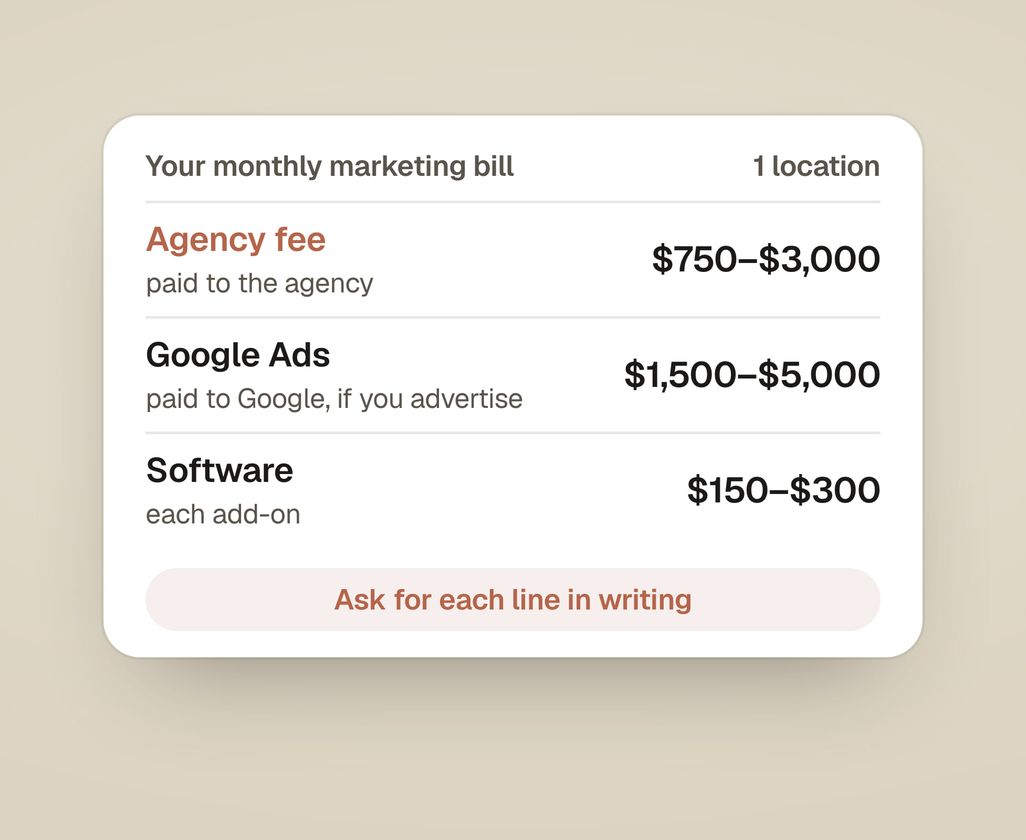
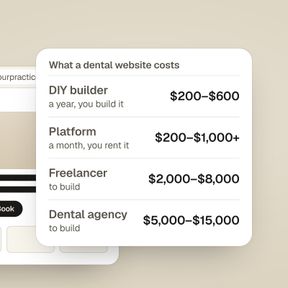
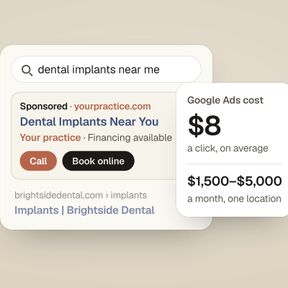
For one independent dental practice in the US, an agency usually charges about $750 to $3,000 a month. If you run Google Ads, the ad spend is extra and goes straight to Google, often $1,500 to $5,000 a month. A new website is a separate one-time cost of about $5,000 to $15,000.
The total matters less than three things: what the fee pays for, who owns the accounts, and what it costs to leave. Two quotes of $2,000 a month can buy very different work. This guide shows how to tell them apart.
What do dental practices pay each month?
In October 2026 we checked the websites of 45 US dental and medical marketing agencies. Only about 1 in 4 published any price. Then we read the pricing pages, terms of service and public price leaks of 10 of them (9 in the US) line by line. Here is what the ones with visible numbers charge.
| What you buy | What we found | Notes |
|---|---|---|
| SEO only (pages, Google listing, local search) | $575 to $1,500 a month | Published by one dental agency |
| A monthly marketing plan | $750 to $2,000 a month | Published by another dental agency |
| Agency management fee | $1,500 to $3,000 a month | One aesthetic agency’s range, from a public leak |
| High-touch agency | $5,000 a month minimum | One agency’s minimum, listed on Clutch |
| Software add-ons (review tools, patient messaging) | $150 to $300 a month each | Sold on top of the plan |
| Group practices and DSOs | Budgets from $50,000 a month | One agency’s form starts here. Not built for a single practice |
Google Ads spend sits outside all of these. Our guide to what Google Ads cost for dentists covers clicks, budgets and cost per new patient. If you also offer Botox or fillers, ads for them follow stricter rules. Our dental and aesthetic marketing guides cover them.
Where does the money actually go?
Every marketing bill splits into three parts. Ask for each one in writing.
- The agency’s fee. This pays for people’s time: writing pages, fixing the website, managing your Google listing, running ads, reporting. This is the number to compare between agencies.
- Media. The money Google charges for ad clicks. It should go from your card to Google, with nothing added.
- Tools and one-time costs. Website builds, software subscriptions, photo shoots, setup fees.
The trap is a single number that mixes them. “$3,000 a month” can mean $3,000 of work, or $1,000 of work plus $2,000 of ads, or a fee charged as a share of a budget you never fully spend. You can only compare quotes once they are split.
What should $1,000 to $2,000 a month buy?
This is the range where most single practices land, so it helps to know what a fair month of work looks like. You should be able to point to most of this:
- Your Google listing kept current: services, hours, photos and posts.
- Every new review answered, usually within a day or two.
- New pages on your website, often two to four a month, each for a treatment you want more of (implants, Invisalign, emergency visits).
- Problems on your website found and fixed: slow pages, broken forms, pages Google can’t read.
- A short monthly report: what was done, how many people found you on Google, called or asked for directions, and how you compare with the three practices above you on Google Maps.
If a quote can’t tell you what happens in month three, it isn’t a plan yet. Ask for the first 90 days in writing.
How do you know if it’s paying for itself?
Skip the percentage rules for a moment and do this sum with your own numbers:
Monthly marketing cost ÷ what one new patient is worth to you = new patients you need each month to break even.
An example with round numbers: you spend $2,000 a month in total. Your office manager pulls a report and finds a new patient brings in about $800 in their first year. You need 2 to 3 extra new patients a month to cover the cost. One implant case can cover several months on its own.
Two things make this sum honest:
- Use first-year value, not lifetime value. Lifetime numbers make almost any spend look good.
- Count only new patients the marketing brought. Your booking software can usually tag how a new patient found you. If it can’t, ask at the front desk and write it down for a month.
Then give it time. Google Ads can bring calls within weeks. Fixes to your Google listing and reviews often show within one to three months. New pages usually take three to six months to show up on Google. Judge month one on the work done. Judge results from month three.
What costs don’t show on the price sheet?
These came from agencies’ own terms of service, not from guesswork. Each one turns a fair-looking price into a bigger bill.
- A fee on the whole ad budget. One agency’s terms charge 30 to 50% of the gross budget, plus a 3% admin fee. That means 43 to 100% on top of what actually reaches Google.
- Fees on money you didn’t spend. The same terms charge the fee while ads are paused and on unspent budget.
- Ad accounts that stay with the agency. One agency tells clients “you own all our work”. Its terms say it keeps the Google and Meta ad accounts. When you leave, years of ad history go with them.
- Exit fees. One contract charges 50% of the remaining term if you leave early.
- 12-month contracts that renew. 3 of the 10 agencies use them. One renews automatically at “the then published rates”, and publishes none.
- A website you rent. At one agency, 22 of 25 client sites we checked sat on its own system. If you leave, the site stays.
- A gag clause. One contract bars you from criticizing the agency for a year after you leave.
All of it is avoidable if you read the terms before you sign.
What should you ask before you sign?
Take these to any agency, including us:
- What is your monthly fee, and what is not included in it?
- Who pays Google for ads, and do you add anything on top?
- Whose name are the Google Ads, Google listing, Analytics and website accounts in?
- How long is the contract, how much notice do I give, and is there an exit fee?
- What will you do in the first 90 days, and what every month after that?
- What does the monthly report show?
- Can I see a named practice you work with now, and call them?
- If I leave, what do I keep?
A good agency answers all eight in writing without a sales call.
When is a cheaper option enough?
Not every practice needs an agency.
- Your schedule is full and new patients come from referrals. Claim your Google Business Profile, ask every happy patient for a review, and keep your website’s hours and phone number right. That costs you time, not money.
- You are already in the top three on Google Maps for your main searches. You may only need someone to keep the listing and reviews current.
- You are opening a new practice. Spend first on a website you own and a complete Google listing. Monthly work makes more sense once those exist.
An agency earns its fee when you are not in the top three near your office, when the practices above you have more reviews and better pages, or when you want more of a specific high-value treatment.
Where does Studio Smirk sit?
Our prices are published on our pricing page: two monthly plans, month to month, with 30 days’ notice and no exit fee. If we run your ads, Google bills your card directly, our ads fee is published too, and we add nothing to what Google charges. Every account and your website stay in your practice’s name from day one.
Aditya Kaushal plans and does the work with a small team, and he is the person you talk to.
The practice audit shows where you stand on Google Maps against the three practices above you, and what to fix first. It costs nothing and comes by email. Get my practice audit.