How Much Do Google Ads Cost for Dentists? Budgets, Clicks and Setup
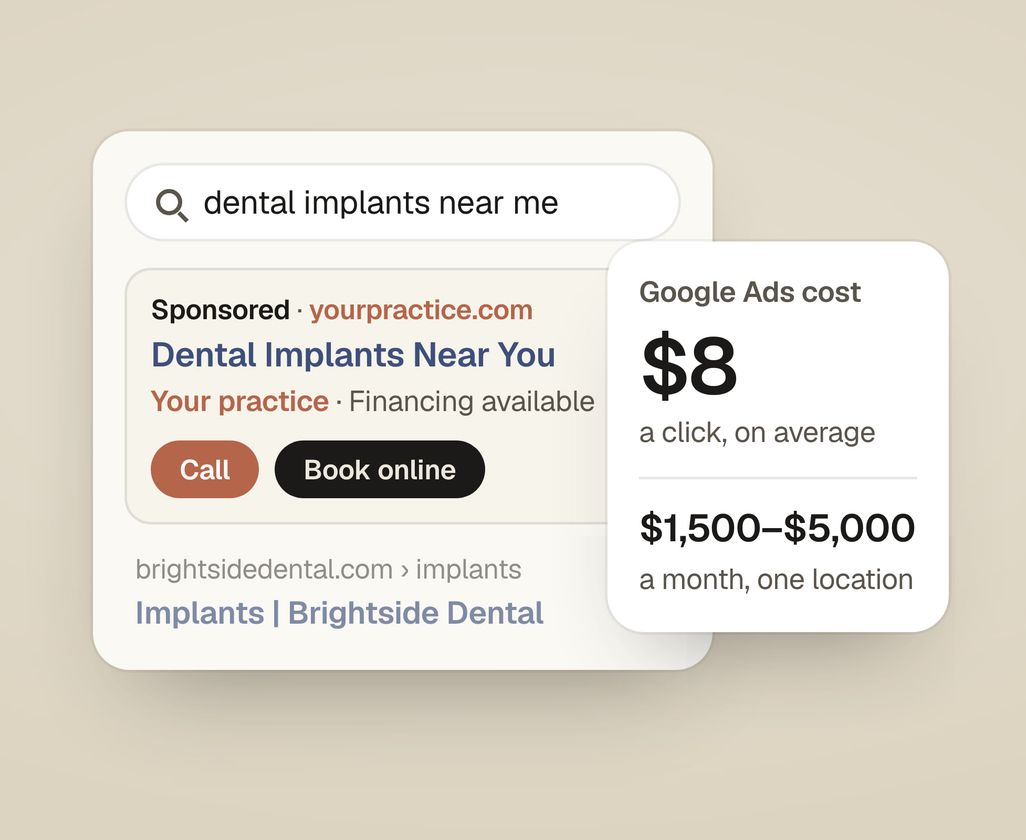
Google Ads for a dental practice costs about $8 a click on average, according to LocalIQ’s 2026 benchmarks for dentists and dental services, and implant or cosmetic searches in busy metros cost more. To know if it is worth it, compare what a booked new patient costs you with what that patient is worth to the practice.
What does a Google Ads click cost for a dental practice?
Google Ads is an auction. You pay when someone clicks, and the price depends on how many practices bid on the same search in the same area. A useful public reference point is LocalIQ and WordStream’s 2026 search advertising benchmarks (updated June 2026), drawn from thousands of their customers’ Google and Microsoft Ads campaigns:
| Benchmark (LocalIQ, 2026) | Dentists and dental services | All industries |
|---|---|---|
| Average cost per click | $8.00 | $5.42 |
| Average click-through rate | 5.66% | 6.64% |
| Average conversion rate | 10.67% | 8.18% |
| Average cost per lead | $72.97 | $66.69 |
These are averages across many campaigns. Click costs swing widely by treatment and market. A search like “teeth cleaning near me” usually costs less than average. Searches for dental implants, All-on-4, Invisalign or veneers often cost several times more. Practices that earn a lot per case bid on them, and so do national aligner brands. Click costs in New York, Los Angeles or Miami will not look like click costs in a small town.
To see the range for your area, open Google’s Keyword Planner, enter your treatments, set the location to the ZIP codes your patients come from, and read the top-of-page bid range. It is free and it is the only figure that is about your market.
What does a new patient cost from Google Ads?
The click is only the first number. What you want to know is the cost per lead (a call, a booking or a form) and then the cost per booked new patient.
| Step | Practice A: good page, phones answered | Practice B: homepage, missed calls |
|---|---|---|
| Cost per click | $8 | $8 |
| Visitors who call or book | 1 in 10 (10%) | 1 in 25 (4%) |
| Cost per lead | $80 | $200 |
| Leads who become patients | 1 in 2 (50%) | 1 in 3 (33%) |
| Ad cost per new patient | $160 | $600 |
The figures are illustrative. Same clicks and same budget, but Practice B pays nearly four times as much per new patient. Practice B’s bids are fine. Its clicks land on a homepage instead of a treatment page, and its calls go unanswered at lunch.
Now set that beside what the patient is worth. A new hygiene patient who stays for years is worth a lot more than one cleaning. A single implant case is often worth several thousand dollars, so it can carry a much higher cost per patient. Make that comparison for each treatment you plan to advertise.
What monthly budget makes sense for a dental practice?
For a single location, ad spend typically runs about $1,500 to $5,000 a month, paid directly to Google. Treat that as a common range. The right starting budget is the one that buys enough clicks to read the results within a month or two.
A quick way to check: at $8 a click, $1,500 buys about 190 clicks. At a 10% conversion rate that is about 19 leads. That is enough to start seeing which treatment and which page work. At $500 a month in a competitive metro you might get six leads, and six is too few to tell good ads from bad luck.
Start with one or two treatments, run them properly, and add more once the first ones have numbers behind them.
Which dental treatments are worth advertising?
Advertise treatments where the patient needs to decide soon, and where the treatment is worth more than the ad cost of finding that patient.
- Emergency dental care. “Emergency dentist”, “tooth pain”, “broken tooth”. These patients need someone today and book fast. Run these ads only when someone will answer the phone.
- Dental implants and full-arch cases. Clicks are expensive, each case is worth a lot, and patients research for a long time. Worth it only with a proper implant page: cost range, financing, the process, the dentist’s training, real cases with consent. Our guide on getting more dental implant patients covers that page.
- Clear aligners. You compete with national brands. It works when the page is specific: your fee range, your doctor, your financing, consented before-and-after photos. Our guide to Invisalign marketing for dentists covers the page and where aligner patients come from.
- Cosmetic work such as veneers and whitening, with a clear “from” price.
- New patient exams, if your area has open demand and your hygiene schedule has room.
Usually not worth it: “dentist” or “dentist near me” on its own. These searches are broad, and many practices bid on them. A complete Google Business Profile wins much of that traffic in the Google Maps results without paying for it.
What has to be in place before the first dollar?
An ad sends a patient somewhere. That page has to convince them, and someone has to answer when they call. Before spending:
- A complete Google Business Profile. Your ad and the Google Maps results show on the same screen. A half-empty listing next to your own ad makes the ad less convincing.
- A landing page for each treatment you advertise. What it is, what it costs, financing, the dentist, real reviews, and a Call and a Book button. Not the homepage.
- Phones answered during ad hours. Schedule ads for staffed hours. You pay for the click whether or not anyone picks up.
- Call and booking tracking, in your accounts. Google Ads conversion tracking, which counts the calls and booking requests that come from your ads. Some practices also use call tracking numbers, so every call traces back to the ad that caused it. Without this you cannot work out the cost per patient.
- A number for what a new patient is worth, per treatment. Without it, no result can be judged.
The how to get more patients guide covers the order to fix these in.
How should a dental Google Ads account be set up?
- One campaign per treatment, each with its own landing page and budget, so you can see which treatment pays.
- Tight locations. The ZIP codes and radius patients really travel from. A patient 40 minutes away rarely books a cleaning.
- A schedule that matches the front desk. Ads off when nobody answers.
- Negative keywords from day one. “Free”, “school”, “jobs”, “salary”, “insurance card”, “dental assistant”, plus treatments you do not offer.
- Phrase and exact match to start. These keyword settings show your ad only for searches close to the words you chose. Broad match can spend on searches you never meant to pay for, until there is enough conversion data to guide it.
- Call assets and location assets on, so patients can call or get directions from the ad.
- Care with automated campaign types. Performance Max and similar campaigns can spend across many Google sites and apps, and you see little of where the money went. Use them once search campaigns have conversion data, and watch the search terms.
Who should own the ad account, and what should management cost?
The practice should own the account. That means:
- The Google Ads account is created in the practice’s name and billed to the practice’s card. Google bills you directly for clicks.
- The agency gets manager access, which you can remove at any time.
- Conversion tracking, call-tracking numbers and Analytics are in your accounts too.
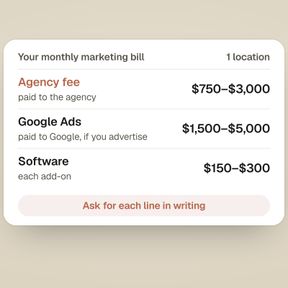
Management fees in the US usually take one of three shapes: a flat monthly fee, a percentage of ad spend (often in the 10 to 20% range), or a mix. In our October 2026 review of US agencies, published examples included $1,500 to $1,750 a month or 20% of spend at one aesthetic agency. Any of these can be fair. Some agencies’ written terms had arrangements to avoid. Some run your ads in the agency’s own account. Some charge a fee on the whole budget that works out to an extra charge on top of what Google bills. Some charge fees on budget you never spent. Some contracts bar you from criticizing the agency after you leave.
Ask before you sign: whose account is it, who pays Google, does the agency add anything to what Google charges, and what do I keep if I leave? Our own fee is published on our pricing page, and our Google Ads service page explains how we run campaigns. For the whole monthly marketing bill, not only ads, see what dental marketing costs a month. Local Services Ads, the pay-per-lead ads with the Google Verified badge, work differently; see our guide to Local Services Ads for dentists.
What ad rules apply to dental practices?
This is general information, not legal advice. Check the specifics with your compliance advisor.
- Healthcare is a sensitive category in Google Ads. Google’s personalized advertising policy restricts targeting people based on health conditions or treatments. In practice, most remarketing (showing ads to people who visited your treatment pages) is off-limits for patient-facing dental ads. So are uploading patient lists to target ads, and similar audience tools. Search campaigns, where the patient types what they need, are where dental ads work.
- Claims must be accurate. No guaranteed results, no misleading before-and-after images, no “pain-free” promises you cannot stand behind. Ads that overclaim get disapproved. If you also offer Botox or fillers, our guide to med spa advertising explains the extra rules for injectables.
- Brand and product names. Product names such as aligner brands are trademarks, and Google can restrict their use in ad text. Check before building ads around a brand name.
- Your state dental board’s advertising rules apply to ads too, including who may call themselves a specialist and how fees and discounts are stated.
- Keep patient information out of ad platforms. Conversion tracking should record that a call or booking happened, not what the patient typed or which condition they mentioned. Federal guidance on tracking technologies has shifted since 2022, and pages patients log into are still covered by HIPAA. Ask your compliance advisor before adding any tracking code (a “pixel”) to forms patients fill in.
How do you read the first 90 days?
After each month, look at three numbers per treatment:
- Cost per lead: spend divided by calls, bookings and form requests.
- Cost per new patient: spend divided by leads who actually booked and showed.
- What those patients were worth, at least in first-year treatment value.
If the third number is comfortably larger than the second, keep going and consider raising the budget. If it is not, the fix is usually the landing page or the phones rather than the bids. Change one thing, run another month, and read again. Anyone who promises a set number of new patients before the first month has run is guessing.
When should a dental practice not run Google Ads?
- The Google Business Profile is half-finished. Fix it first; it is free and it wins the broad searches.
- The website is slow, or has no page for the treatment you would advertise.
- Nobody answers the phone at lunch or after 5pm, and you cannot schedule around that.
- You cannot say what a new patient is worth.
- The budget is so small that a month will not produce enough leads to read.
In each of those cases, the money does more on the listing, the treatment pages and the reviews, which keep working after you stop paying.
How does Studio Smirk handle Google Ads for practices?
Before any ad runs, we check your Google listing and the treatment pages the ads will send people to. We set up conversion tracking in your own Google Ads account, so it counts the calls and booking requests that come from your ads. Each month we show you what the ads cost and how many calls and booking requests they brought in. The ad account is yours, Google charges your card, and we add nothing to what Google charges. Read how we work with dentists and cosmetic and implant practices.
The audit compares your listing, reviews and website with the top three practices near you on Google, and shows the fixes to make before or alongside ads. Get my practice audit.