Invisalign Marketing for Dentists: Where a General Practice Finds Aligner Patients
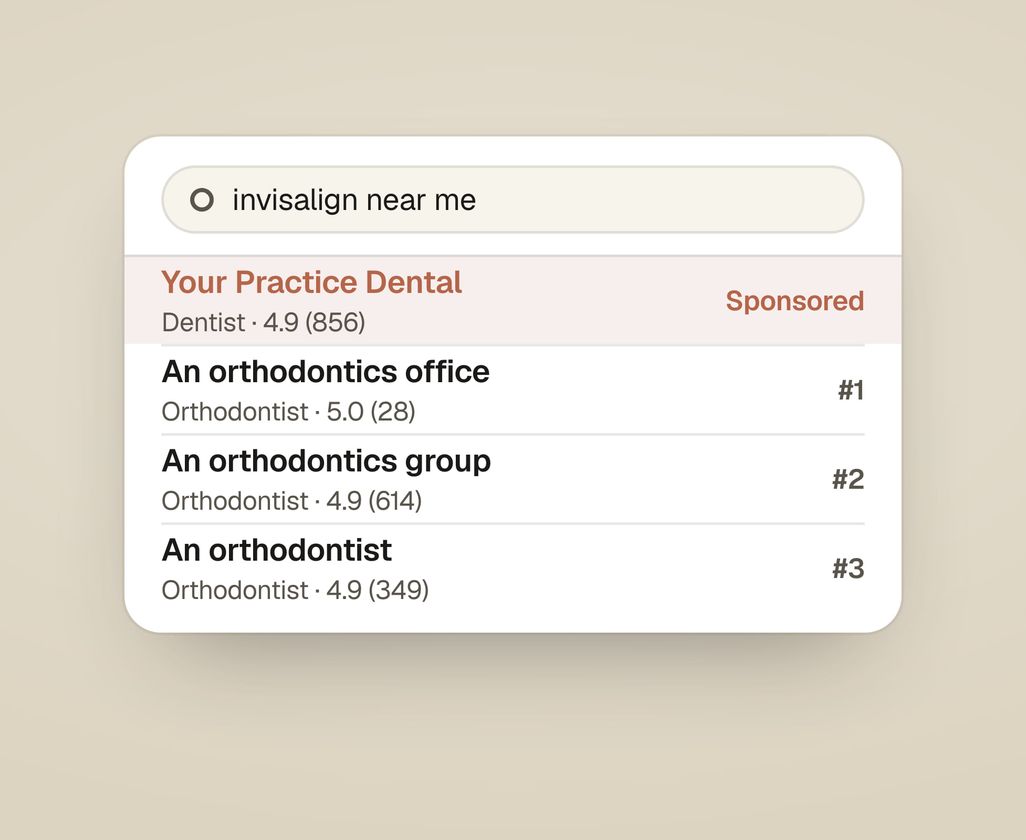
For a general dental practice, Invisalign marketing starts with its own patients and a clear page that answers one question: why come to you and not an orthodontist? Google’s local results for “Invisalign” are mostly orthodontists, so a general practice rarely wins there on reviews alone. It wins with its own patients, its page and its ads.
This guide shows who fills those results today, where aligner patients really come from, what the page needs, and the rules on using the Invisalign name.
Who shows up when patients search for Invisalign?
On 12 October 2026 we looked at Google’s local results for “invisalign in Plano TX” and “invisalign in Frisco TX”.
- Orthodontists fill the results. 18 of the 20 practices in the two top 10s listed “Orthodontist” as their category. In Frisco, 19 of the first 20 were orthodontists.
- General dentists showed up in the paid spots. In Plano, both sponsored listings above the results were general or cosmetic practices.
- Reviews didn’t decide it. Plano’s #1 for “Invisalign” was an orthodontist with 28 reviews, above orthodontists with several hundred.
Google matches the search “Invisalign” to orthodontists first. For a general practice, the map results for this word are the hardest place to win, and the least important.
Where do aligner patients come from for a general practice?
Four places, roughly in order of how cheap each patient is:
- Your own patients. Someone in the hygiene chair who mentions crowded or spaced teeth is the easiest aligner case to start. They already trust you, and the scan takes minutes. Train the hygienist and dentist to offer a scan and a preview of the result whenever it comes up.
- Invisalign’s own doctor locator. Patients use it to find providers near them. It shows your provider tier, which reflects how many cases your office treats, not how skilled the dentist is. Keep your listing there current.
- Your Invisalign page. Patients comparing options read it at night before they book. It has to answer their questions, starting with the one below.
- Ads. Google Ads put you above the orthodontists for aligner searches, the way the Plano practices did. They work only when they send people to that page.
Reviews from aligner patients help too. Ask every patient for a review the same way, and patients who loved their result will often mention it on their own.
What question must your page answer first?
“Should I see an orthodontist instead?” Every aligner patient wonders it, and most general practice pages ignore it. Answer it plainly:
- Which cases you treat, such as mild to moderate crowding and spacing, and which you refer to an orthodontist, such as complex bite problems.
- Who plans the treatment and how many aligner cases they have done.
- What happens if the teeth don’t track as planned: refinements, and whether they are included.
- What it costs you to switch if you later need an orthodontist.
An honest answer here does more than any badge. It tells the patient you won’t take on a case you shouldn’t.
What should your Invisalign page include?
- A price range or a “from” price, and a monthly payment, with what’s included: the scan, the aligners, refinements and the first set of retainers.
- How long treatment usually takes and how often they visit.
- Who it suits, in plain words, and what you do when it doesn’t.
- Your own before-and-after cases, each with written consent.
- The orthodontist question, answered as above.
- A button to book a scan or consult, with what that visit costs and includes.
Name your town and neighborhoods on the page, the way patients search. If you also offer implants or veneers, our guide on getting more dental implant patients uses the same page pattern.
How should you run Invisalign ads?
- Send every click to the Invisalign page, never the homepage.
- Expect to compete with orthodontists and national aligner brands for the same searches. Click costs for aligner searches run well above general dental searches, as our guide to Google Ads costs for dentists shows.
- Use the Invisalign name in ad text only if you are an active provider, and follow Align’s rules for it.
- Judge the ads by scans booked and treatments started, not clicks.
What rules should you know?
- The Invisalign name belongs to Align Technology. Trade press reports that Align has been enforcing its trademark more strictly in marketing. Only active providers may use the name. If you stop offering it, the name has to come off your pages, page titles, image text and ads.
- Orthodontics is an ADA-recognized specialty. A general dentist can offer aligners but should never imply being an orthodontist. Check your state board’s advertising rules.
- Before-and-after photos need written consent and must be your own cases.
- No guarantees about results or timelines.
Where does Studio Smirk sit?
Our Signature plan is built for practices that want more high-value patients, like Invisalign, implant and veneer cases: procedure pages each month, a deep-dive on your top competitors, and a plan for which treatments to push first. Prices are on our pricing page, and you can read how we work with cosmetic and implant practices.
The practice audit shows where you stand on Google against the three practices above you, and what to fix first. Get my practice audit.