How Much Does a Dental Website Cost? What US Practices Pay
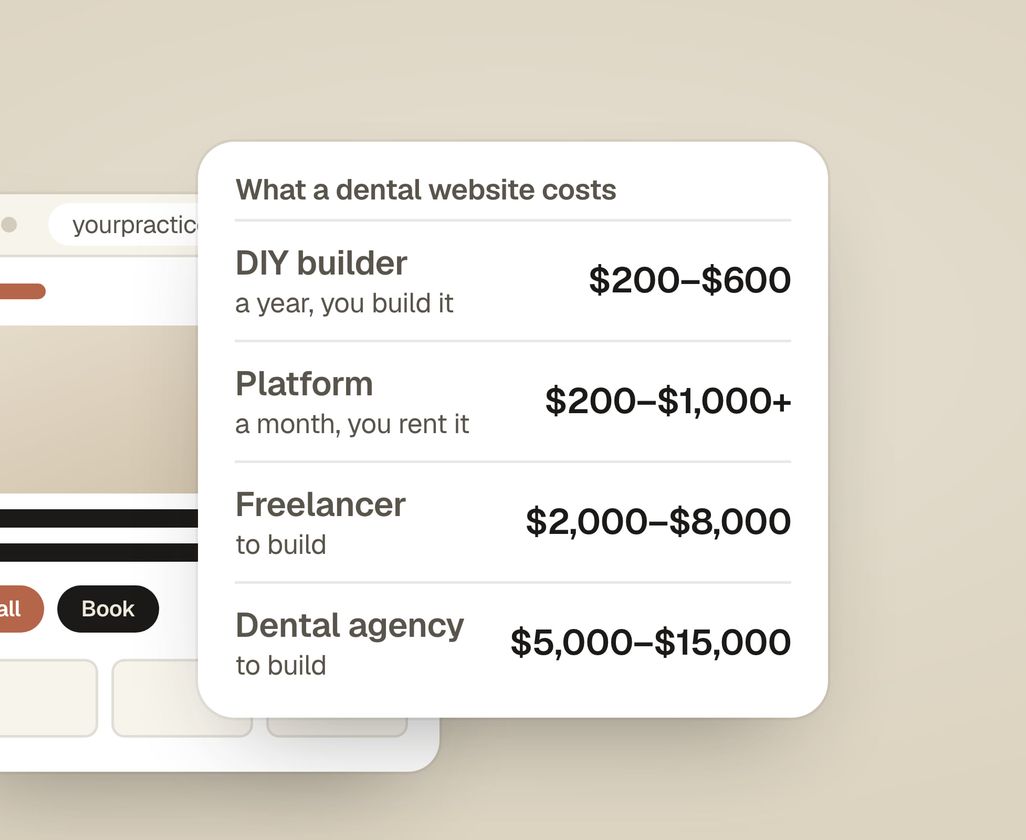
A dental practice website in the US costs anywhere from about $200 a year, built yourself, to $15,000 or more from a dental agency. A site built to bring in patients typically costs $5,000 to $15,000 to build, plus $300 to $3,000 a year to run. The price tells you little about whether the site will bring patients. This guide covers what each option buys, what it costs to run, the US rules a dental site has to meet, and the questions to ask before you pay.
How much does a dental website cost, option by option?
These are typical US market ranges as of October 2026, not quotes. They line up with the prices agencies published when we reviewed 45 US agencies in October 2026. One dental agency lists custom websites at $6,500. Another sets a $5,000 minimum. Subscription bundles ran from a $199 platform site to $595 to $1,145 a month for a site plus SEO.
| Option | Upfront | Ongoing | Who owns the site | Fits a practice that |
|---|---|---|---|---|
| DIY builder (Wix, Squarespace and similar) | $0 | About $200 to $600 a year | You | Is busy on referrals and only needs its address and hours online |
| Subscription platform (dental or medical) | Setup fee, often $0 to $2,000 | Monthly fee, from about $200 to $1,000+ with SEO bundled | Usually the platform | Wants it handled and accepts renting |
| Freelancer | About $2,000 to $8,000 | Hosting plus someone to maintain it | You, if the accounts are in your name | Has a clear brief and a freelancer with dental work to show |
| Dental agency, custom build | About $5,000 to $15,000 | Hosting, care plan, often ongoing SEO | You, if the contract says so | Wants the site to rank for treatments and book patients |
| Large cosmetic, implant or multi-location site | $15,000 and up | As above | You, if the contract says so | Sells high-value cases and needs a full procedure library |
What does a DIY website builder get you?
You get a basic site for the cost of a subscription and a weekend of your time. It will look like other practices on the same template, it will rarely rank for treatment searches, and the builder will not write your treatment pages or set up call tracking. That is fine for a practice that is booked solid and only needs the address, hours and phone number online. It is a weak place to send patients from your Google listing or from paid ads.
What does a subscription platform get you?
A dental or medical website platform builds the site on its own system and charges monthly, often with SEO, reviews or ads bundled in. You get one bill and nothing to manage. The catch is ownership. In our research, several platforms licensed the site to the practice rather than handing it over, and one only made the home and contact pages transferable. If you cancel, you may keep the domain and lose the site. Before comparing prices, ask what you take with you when you leave.
What does a freelancer get you?
A custom-looking site from one person, usually on WordPress. Quality depends entirely on the person. Common gaps include one “services” page instead of a page for each treatment, and no call or form tracking. Many skip local search setup, and the site gets slower over a year as plugins pile up. Ask who maintains it in month seven, and make sure the hosting and domain logins are in the practice’s name.
What does a dental agency build get you?
This is the site built to bring in patients. It has a page for each treatment, written for what patients search. It shows the dentists with credentials and real photos, and quotes reviews. Every page has a Call and a Book button. Analytics and Search Console sit in the practice’s accounts, and so does call tracking if you use it. The price reflects the pages and the tracking more than the design. A single-location general practice with ten core treatments sits near the bottom of the range. A cosmetic or implant practice with a full procedure library, consented before-and-after galleries and several providers sits near the top or above it.
Why do dental website prices vary so much?
Two practices can pay the same amount and get very different things. One gets five template pages, stock photos of smiles and a contact form nobody uses. The other gets a page for every treatment, the dentist’s credentials up front, real reviews, a booking button on every page, and tracking that shows which page each call came from. Both get called “a website”.
The real question is how much work the site has to do. A practice with a waiting list needs the site to look credible when a referred patient checks it. A practice with open hygiene slots, or one that wants more implant and Invisalign cases, needs the site to rank and to book. Compare quotes on that work; page count says little.
What does a dental website cost to run each year?
The build is a one-time number. These are the costs that come back every year:
| Cost | Typical range | Notes |
|---|---|---|
| Domain | $10 to $30 a year | Register it in the practice’s name, on a practice email address |
| Hosting, static site | Under $25 a month | Fast and cheap to host; few moving parts to break |
| Hosting, WordPress | $25 to $100 a month | Cheap hosting makes WordPress slow; managed hosting costs more |
| Care plan | $50 to $300 a month | Updates, backups, security, fixing a form that stopped sending |
| Photography | $500 to $2,500 per shoot | A half-day with a local photographer; usually the biggest visual upgrade for the money |
| New treatment pages | Varies | Some agencies include them; many freelancers and builders do not |
A static site built without a heavy content system is the cheapest to run and the hardest to break. A WordPress site is easier for staff to edit but needs paid hosting and regular updates, or it slows down and becomes a security risk. Our website care page explains what ongoing care covers.
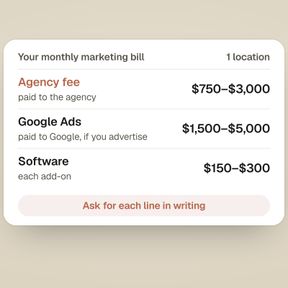
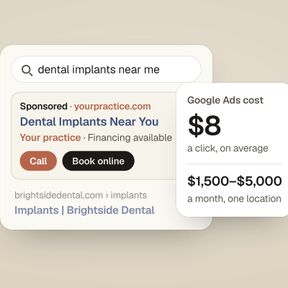
The website is one part of the bill. For the monthly side (Google listing, reviews, pages and ads), see what dental marketing costs a month.
What should a dental website include, whatever you pay?
Check every quote against this list. A cheap site that misses one of these gets expensive later.
- Fast on a phone. Test your current site on your own phone, on cellular data. If it takes more than about three seconds to show anything, patients leave.
- The dentists by name, with credentials and real photos. DDS or DMD, where they trained, what they focus on.
- A page for every core treatment. What it is, who it suits, what to expect, how many visits, and a price range or “from” price where you are comfortable giving one.
- Insurance and payment information. Which PPO plans you are in network with, whether you file claims for out-of-network patients, and financing options. US patients look for this before they call.
- A Call and a Book button on every page, linked to online booking or a request form. Many patients would rather book at 10pm than call at 10am.
- Real reviews, so the site and your Google listing tell the same story.
- Tracking in the practice’s accounts: Google Analytics and Search Console, plus call tracking if you use it, so you can see what the site sends you.
- Name, address, phone and hours that match your Google Business Profile exactly.
What US rules does a dental website have to meet?
Templates rarely mention these. A good builder raises them before you ask. None of this is legal advice; check the specifics with your compliance advisor or attorney.
- Accessibility. Website accessibility lawsuits under the Americans with Disabilities Act are common, and dental practices are among the businesses that get named. Build to WCAG 2.1 AA: readable contrast, alt text on images, a site you can use with a keyboard, captions on video. Ask how it was tested.
- Health information in forms. A form that asks about symptoms, medical history or insurance details collects health information. Use a form or booking tool whose vendor will sign a business associate agreement (BAA). Do not have form answers emailed around in plain text. A simple “name, phone, best time to call” form carries far less risk.
- Tracking. Do not send what a patient types into a form to Google, Meta or any ad platform. Count the event (a call, a booking), not the content.
- Advertising rules. Your state dental board regulates dental advertising: who can call themselves a specialist, how before-and-after photos and testimonials are used, how prices and discounts are stated. Your website counts as advertising.
- Before-and-after photos. Written patient consent for every photo, kept on file.
Who should own the website?
The practice. The domain, hosting, code, analytics, Search Console and any call-tracking numbers should be in accounts the practice controls, from day one, and the contract should say so in plain words.
In our October 2026 review of 45 US agencies, none of the 39 homepages we could read promised that the practice owns its site. Several contracts we read said the opposite of the marketing. Some agencies kept the ad accounts, some licensed the site rather than handing it over, and some made only a couple of pages transferable. If you ever change providers, ownership decides whether you take the site with you or start over.
What questions should you ask before you sign?
Ask these before you ask the price.
- Who owns the domain, the hosting, the code and the analytics, and does the contract say so?
- Is the site built on a platform I can take with me, or do I lose it if I cancel?
- Are treatment pages included, how many, and who writes them?
- Is call and form tracking set up, and in whose account?
- Is the site built to WCAG 2.1 AA, and how was it tested?
- Which form or booking tool will you use, and will the vendor sign a BAA?
- What does year two cost, all in?
- Can I see a live dental site you built, and its Google listing next to it?
- What does it cost to leave? The right answer is nothing, because you already own it all.
Where does Studio Smirk sit?
We build custom websites for dental and aesthetic practices. You own the code, and the site is hosted in your own account. Each site has a page for each main treatment, and a Call and a Book button on every page. We set up Google Analytics and Search Console in your name.
We sell two websites at fixed prices: the Practice Website, and the Signature Website for practices that offer many procedures. You pay half up front and half at launch. Both prices are published on our pricing page.
Two dental sites we built are live and named, both in Bangalore, India: The Tooth Corner and Tooth District. Click through and judge the work yourself.
Read how we build dental websites, or see how we work with dentists and cosmetic and implant practices. You can also take the question list above to any builder you are considering.
The audit compares your website, your reviews and your spot on Google Maps with the top three practices near you on Google. It also shows what you may be losing each month, before you commit to anything. Get my practice audit.